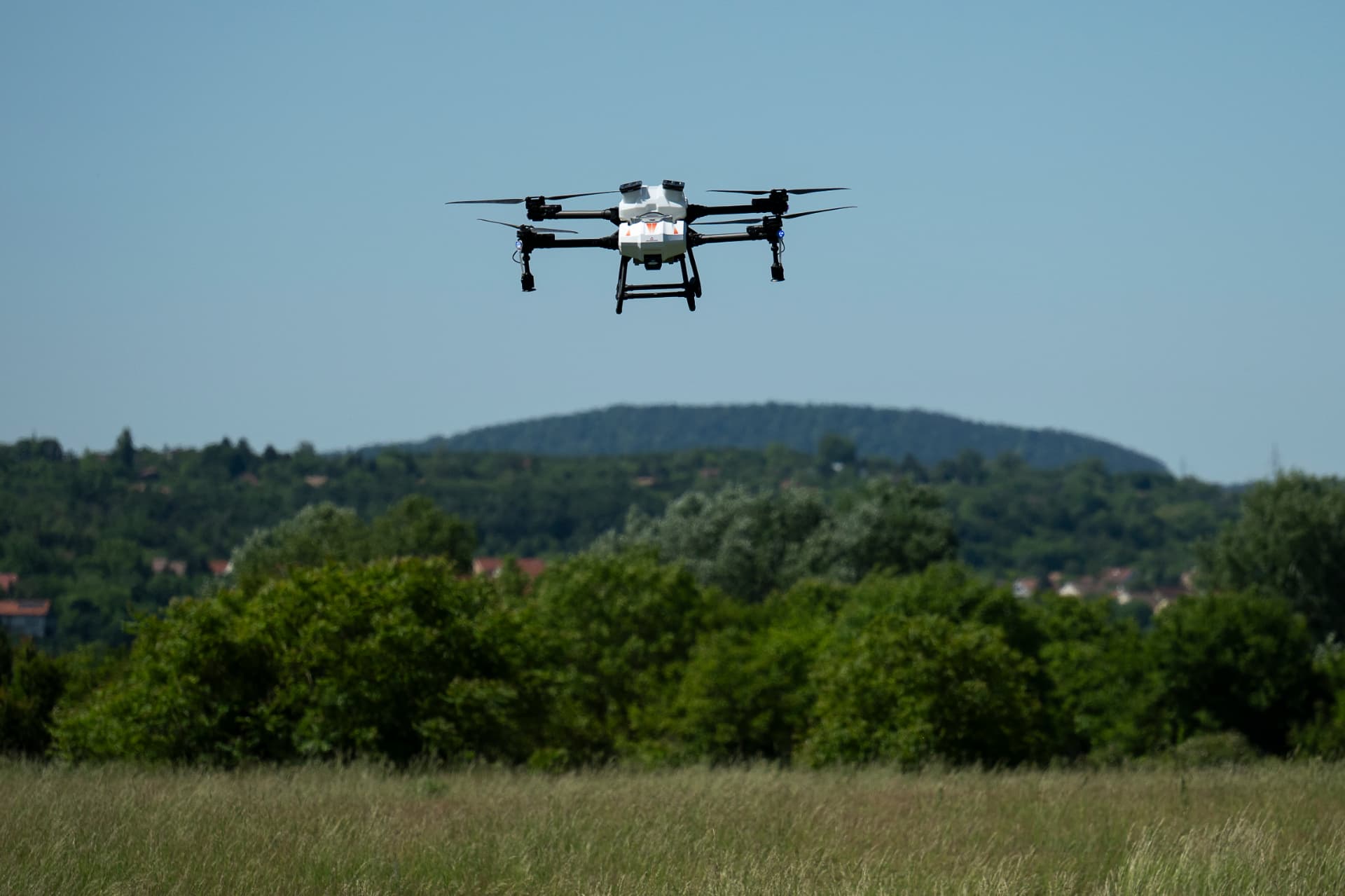
Capability — Precision agriculture
Programmes, not passes.
Spraying, spreading, biological release and greenhouse shading run as a managed seasonal programme with centimetre-accurate placement and a full application record.
Less water
85–95% less carrier volume than ground application.
Less chemical
Up to 50% reduction through spot and zone treatment.
No compaction
No machine traffic, no wheelings, no trampling.
Lower cost
€0.60–€0.90/ha against €6–€15/ha conventional.
A fleet sized to the farm, flown to a prescription.
A 250 ha operation is typically served by an L30 V2 for broadacre work and an L10 V2 for small plots, complex boundaries and biologicals, sharing a single RTK base station. Realistic throughput is around 15 ha/hour in open fields and 3–5 ha/hour in orchards and vineyards, and the fleet doubles when the operating window tightens.
Missions are planned from existing field boundaries and prescription maps, with altitude, speed and rate set per zone. LiDAR terrain following and obstacle avoidance hold the boom at working height over uneven ground, and every flight leaves a log for record-keeping and compliance.
Field results back the model: Tokaj vineyards recorded 50% lower operating cost, 54% less pesticide, 90% less water and 82% lower CO₂; sunflower work moved from €15/ha by tractor to €1/ha by air on 15 l/ha instead of 300.
Programmes
- Broadacre and orchard spraying
- Granular spreading, 0.5–6 mm, 4–9 m width
- Trichogramma biological release, up to 36 ha/hour
- Greenhouse shading, ~2 h/ha against 6–8 h/ha
Controls
- RTK centimetre positioning
- Prescription map spot application
- LiDAR terrain following
- Per-mission application record
Technical documentation